Pages

Thursday, October 25, 2012

iLike iBooks

This week's class discussion was on content creation and interactive eBooks/iBooks. We opened up by going through some of the features of these tools, which I'm somewhat familiar with because I own a Kindle. For example, Dr. Schugar demonstrated the ability to highlight text, make notes, define words, and even make your own note cards to study from, which I thought was pretty incredible. Here's an example of the notecard feature, pulled from Gizmodo.

Notecard feature makes studying a breeze
After the talk about features came a deeper discussion: will these eBooks be beneficial to us (and our students) in our future classrooms? I know I've heard people voice concerns about how meaningful resources like this are. I think in the end you just have to be careful which eBooks you select. It's the same for regular books - as long as you pay attention to the quality of the book in question, I wholeheartedly believe eBooks would be extremely meaningful to use in the classroom. The technology aspect really appeals to students in this day and age. However, I also believe that there's a limit to how much I would use these tools. I would use it to enhance a lesson here and there, but at the end of the day I think students should be reading good old fashioned books. Technology is great, but it could never replace books, at least not in my world.

We also talked about content creation for a few minutes. Dr. Schugar showed us iBooks Author. This app is free on the App Store and, in short, it allows you to create and publish your own books. There are templates to select from, options to completely customize the book and make it your own (you pick the font, format, etc), and even the ability to add widgets. Check out this article on iBooks Author over on Mashable. I think this is a really amazing idea. It would be such a nice tool for the classroom - not only could you make books, but your students could use it as well! I would love to let students play around with this app and let them experience what it's like to be an "author". 

Overall, I really enjoyed this class discussion because it brought a lot of great resources to my attention. I sound like an Apple spokesperson - but I assure you that these opinions are my own! I'd love to hear your opinions! Feel free to comment, fellow bloggers.

Sunday, October 21, 2012

Flipping Out!

Last week in class, we discussed a topic that I'd never learned about before - flipped classrooms. It's a term that I'd heard thrown around but never took the time to research or understand.

So what is a flipped classroom? The instruction that is usually done at school is done at home and vice versa. The traditional classroom model is just flipped around - hence the term flipped classroom. You may be asking yourself - how does this work? Flipped classrooms incorporate technology. At home, the students prepare for the following day's class by watching the lecture at home. One method is to have the teacher record the lecture/lesson and then link the students to it. This way, the student gets all the background info they need at home. Then in class the next day, the students can spend their time reinforcing the learning and and applying it to activities in class.

I haven't decided if I like flipped classrooms or not. There are certainly many pros to this method, but there are also cons that have me on the fence. First, let me go into what I do like about this idea. For one, it's extremely student centered, which I love. I know how rough it can be to sit through nothing but lecture. This method allows the lecture to happen at home so the students can be the center of attention during class time. This method also makes it easy to differentiate. You could create different videos for different levels. That way all of the students could get the necessary information on an appropriate level. The technology aspect of this method could also motivate students. Instead of going home and reading, they could watch a fun video and get the same information. However, there are some major issues I have with this method. Number one, it assumes that all students could access these lectures from home. Some families may not have internet access, which could be a major disadvantage. As a reading minor, I don't like how this method de-emphasizes reading. I think our students should be reading text, not relying so much on computers and other forms of technology. Also, what happens if the student is watching the video at home and they have a question? One solution would be to make a discussion board the class can post their questions on, but that would mean the teacher has to constantly check the board. I think it could hurt students to not get a chance to ask questions in real time.

I'm still debating and weighing out the pros and cons of the flipped classroom. Maybe someday I'll give it a try. What do you think about this method? Got any arguments for/against it? Feel free to comment! I'll leave you with a graphic I found at knewton.com that explains the method, how it came to be, and some of its results. Click through to view the full version. Until next time!


Created by Knewton and Column Five Media


Sunday, October 14, 2012

Digital Lit was a hit!

The Digital Literacy Conference was an event being held on my school's campus from 8-1 yesterday, the 13th. In addition to the keynote, each attendee signed up for two breakout sessions. I won't lie, when I found out I had to attend this conference for one of my classes, I wasn't totally thrilled. The thought of waking up early on a Saturday wasn't exactly a happy one. However, I'll admit it - I was wrong! This conference was an amazing opportunity and I had so much fun - the best kind of fun, where you learn something, too. 

First up after sign in was the keynote speaker - Dr. Lisa Zawilinski. Dr. Zawilinski is an assistant professor at the University of Hartford and part of the New Literacies Research Team from the University of Connecticut. If you're in EDM 349 and her name sounds familiar, it's probably because we read her article on HOT blogging for class (you DID read it, right?). Lisa spoke about New Literacy in the 21st century and the idea that we have more access to information than ever before. She shared some of the research that her team has done - which you can view on her website. Her speech was filled with personal experiences - some funny, some extremely touching. She showed us that using technology in a classroom can really make a difference. 

One of the breakout sessions I attended - Extending the Conversation: Using Edmodo to Encourage Participation and Critical Thinking - was also with Dr. Zawilinski. If you've never heard of Edmodo, I highly suggest you check it out. If you don't feel like making an account, let me show you some of the tools Edmodo has with my account. 


Screenshot of my home page on Edmodo - click to view larger!

This is what it looks like when I sign in. It sort of looks like Facebook. As a teacher, I have the option to post a note, an alert, an assignment, a quiz, or a poll. You create a group for your class, give them the class code, and voila! You have a way for everyone to connect. You can give polls to figure out the class's prior knowledge on a topic. You can post pictures, files, etc, for them to look at and talk about. At the end of a unit, you can post a quiz. It's a pretty nice tool for educators. 

One thing Dr. Zawilinski discussed in this session was that you can even use Edmodo in younger grades. Some people would argue that students should be proficient in typing, otherwise it will be laborious. However, she argued that no matter how slow the kids type, it didn't get in the way of them using this website. One girl brought up a really good point - we don't refuse to let kids write before they're well-versed in it - we give them crayons and markers and let them experiment and develop. Why refuse them a keyboard just because they're not fast at typing? Technology can be used at all ages to enhance what's being taught. 

If you went to the conference, how was your experience? If you didn't go, I highly suggest you take advantage next year! 

Saturday, September 29, 2012

Fair Use - A Major PANE

The reason I'm keeping this blog is for EDM 349, also known as "Technology Tools to Transform Teaching and Learning". Basically, this class is the nitty-gritty on how future teachers can integrate technology into their classrooms. Last Monday, our class focused on the topic of fair use. If your first thought is "what's that?", don't worry, I know how you feel. Until now, I'd heard the term 'fair use' get thrown around from time to time, but never knew what it meant. And even after a class period covering its meaning, I'm still a little lost. Although I'm no expert, let me at least share what I know in case this topic has you feeling completely in the dark. 

According to the powerpoint we viewed in class that Dr. Stephen Marvin put together, fair use is "a legal principle that defines the limitations on exclusive rights of copyright holders". Basically, if you're going to use someone else's material, there's guidelines you can follow to be sure that your usage is fair. There are four factors to determine whether use is fair: purpose, amount, nature, and effect (otherwise known as PANE, the inspiration for my post title). Here are some general questions about each factor that can help you determine if your use is fair or not:


Purpose - Are you using the material for commercial uses, or nonprofit educational purposes?

Amount - Are you using a reasonable amount of the work as a whole?
Nature - Is the work fiction or non-fiction? 
Effect - What is the effect on the market? Does your use have an impact on the money the original work makes?

(For more information, I liked the way this site put PANE into perspective.)


For example, say I wanted to use the preamble of the Declaration of Independence in a Social Studies unit. 


Purpose - I would be using this work for nonprofit/educational purposes.

Amount - I would only be using a small portion of the document.
Nature - The work is non-fiction.
Effect - My use has no effect on the market.

Therefore, my use of the preamble would be considered fair. I should note that fair use and its factors aren't technically law, but guidelines you should consider carefully. When in doubt, ask permission. And always, always, always give credit where credit is due. Cite your sources, people! Better safe than sorry. Breaking copyright laws can be bad news. I'm sure you'd rather go through life without being sued (at least, that's how I feel. Somehow I doubt court is as exciting as they make it seem on TV).


Even after all this talk of PANE and fair use in class, I still have my fair share of questions. The guidelines that suggest using a "reasonable amount" of the work is fair. Does anyone else think this is super vague? What counts as a "reasonable amount"? As long as I cite my sources, is everything A-OK? What consequences are there if I slip up? What's a kid-friendly way to teach my students about fair use? 


Hopefully as I look more into these questions/as this class goes on, I'll gain some clarity and some answers to my questions. Do you have the answers? Or more questions? Feel free to comment!


Until next time!


Monday, September 24, 2012

A closer look at the mess

I have an 'about me' page, but I wanted to go into a little more depth and give you a better idea of who I am. As you've probably figured out, my name is Jessica Messner. If you haven't figured it out, ta-da, now you know. If you read my 'about me' page, you really only know a tidbit about who I am as a student. However, as I'm sure you all know, who we are as students and who were are as people are often very different. So here it is - Jessica Messner, the person. 

I'm 20 years old, and I share a birthday with Harry Potter. If you're as into the series as me, be jealous. If you're not into the series..why not!? While we're talking about Harry Potter, let me show you my tattoo:


Excuse the fact that it's freshly done. I got this tattoo in July 2011, and it's one of three tattoos I have. A lot of people don't understand it, so let me explain. In the Harry Potter books, these three stars are in the upper page corners. I've only ever had a handful of people recognize the stars on sight. 

This tattoo says a lot about me. Not just that I'm a HP nerd, but it also reminds me of my love of reading in general. I developed a love of reading at an early age, and it's continued to grow ever since. When people tell me they don't like to read, I really don't understand what they're saying. If any of you ever have any book suggestions, throw them my way! I'll try any book once. 

Let's talk about one of my other loves: ice hockey. Not playing it - I can barely even keep from tripping over my own feet, half the time - but watching...that I can do. And I often do it with a lot of yelling involved (sorry, 5th floor of U Hall!). My love of ice hockey also started young, thanks to my dad. I'm obsessed with one team in particular, the Philadelphia Flyers. I've been going to games since I was literally in the womb. I can't even begin to explain what the team means to me...those who are avid sports fans, you get it. I love the personality of the Flyers - Hartnell's goofiness, Rinaldo's goon-iness, and the amazing relationship they all have with each other. I love seeing a play come together, when you just know they're going to score and you can feel it in your bones. I love seeing them win, obviously. Unfortunately, the fate of the hockey season isn't looking so great right now. For those of you who have no idea what I'm talking about, google 'NHL lockout'. Fingers crossed that they'll work it out, because I don't know what I'll do without my team. Allow me to post one of my favorite pictures related to the Flyers:

Flyers head coach Peter Laviolette yelling at one of the Pittsburgh Penguins coaches - this picture still makes me laugh every time I see it. (Photo credit: found on the700level.com)

Another thing I've really gotten into over this past summer is feminism. Before you roll your eyes, hear me out: what's so wrong about feminism? A lot of people automatically think about "man-haters" or women that grow out their armpit hair. That's not what it's about. What it is about is equality between men and women - and that sounds good to me. If you do want to grow out your armpit hair, well, that's your choice. That's another thing that feminism is about - people should do whatever they want with their own bodies. Nothing to turn your nose up at, in my opinion. Feminism gets a bad reputation and it doesn't deserve it.

Lastly, I wouldn't be the person I am without my family and friends. I think that's a sentiment that most of you can relate to. Instead of writing a bunch of mushy stuff about them, I'll just post a few pictures.
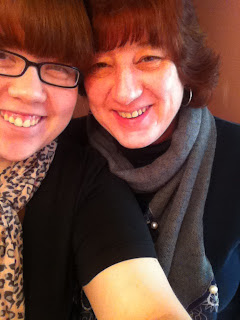
Here's my mama bear. She's awesome, and she's my #1 fan. No one supports what I do and who I am quite like she does.

This is me and my suitemates - Bonnie, Christine, and Sara. These girls are my best friends.

This is my boyfriend, Nick. Once again, I'll save you the mushy stuff - but he's a huge part of my life and I love him very much.

So there you have it. There's a closer look at the mess! Hopefully you decide to stick around. In the coming weeks, I'll be posting a lot about technology and how it relates to education. Stay tuned.